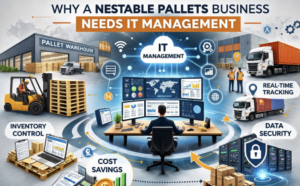
A nestable pallets business lives at the intersection of manufacturing, warehousing, logistics, and customer service. That means every part of the operation depends on timing, visibility, and accuracy. Inventory has to be right. Orders have to move fast. Deliveries have to stay on schedule. Customers need updates. Machines need uptime. Teams need systems that work every day without drama.
That is exactly why IT management is not a luxury for a nestable pallets company. It is a business requirement.
IT management is the discipline of organizing and aligning technology resources with business goals, and it covers everything from network reliability and cybersecurity to software systems, support, and planning. Even Wikipedia’s overview of information technology management frames it around managing technology in line with company needs and priorities, which is exactly what a pallet business needs as it grows.
When IT is managed well, a nestable pallets company can run leaner, ship faster, reduce errors, protect customer and operational data, and make stronger decisions with real-time visibility. When IT is managed poorly, small tech issues turn into expensive operational problems.
IT Management Keeps Operations Moving Without Costly Downtime ⚙️
A nestable pallets business depends on operational continuity. If your production floor, warehouse scanners, shipping software, phones, or internal network goes down, the impact is immediate. Orders stall. Communication breaks. Deliveries get delayed. Teams start working from memory and handwritten notes, and that creates mistakes that are hard to fix later.
Good IT management helps prevent that by putting the right systems in place before something fails. That includes reliable networking, device lifecycle planning, backup connectivity, equipment monitoring, software updates, and support processes that keep issues from snowballing.
This matters even more in industries tied to manufacturing and logistics. Cyber incidents and system outages are no longer rare “big company” problems. Reuters reported on real production disruptions at Jaguar Land Rover after a cyberattack, including shutdowns and delayed manufacturing activity, which shows how quickly technology issues can impact physical operations. Reuters coverage on JLR’s cyberattack disruption and Reuters coverage on phased restart make that risk very clear.
A nestable pallets company may not be a carmaker, but the same principle applies. If your systems go down, your production and shipping performance suffers immediately.
IT Management Strengthens Cybersecurity for a Very Real Threat Landscape 🔐
A pallet company may not think of itself as a cyber target, but attackers do not care whether a company sells software, pallets, or plumbing parts. They care whether the company has systems they can lock, data they can steal, and operations they can disrupt.
Ransomware and credential theft are now common business threats across sectors, including manufacturing and logistics. U.S. agencies have repeatedly warned businesses to raise their cybersecurity posture, and CISA’s guidance strongly recommends that organizations adopt stronger defenses and focus on protecting critical assets. CISA Shields Up guidance for organizations and the broader CISA Shields Up resource page are practical reminders that cybersecurity readiness belongs in daily operations, not just in emergency meetings.
IT management is what turns cybersecurity advice into action. It makes sure someone is actually responsible for patching systems, enforcing multi-factor authentication, managing user permissions, monitoring suspicious activity, segmenting networks, and backing up data.
That structure matters because ransomware activity has remained intense, and reporting on attack trends has shown the scale and speed of growth across organizations worldwide. Recent coverage on ransomware group expansion and victim growth reinforces why even mid-sized businesses need formal IT oversight instead of “we’ll deal with it if it happens.” TechRadar’s ransomware trend report highlights the rising pressure businesses are under.
IT Management Improves Inventory Accuracy and Warehouse Visibility 📊
Nestable pallets move through a lot of hands and locations. Raw materials arrive. Finished pallets are stacked and stored. Orders are picked and loaded. Returns may come back. Reusable assets may cycle across customer sites. Without clean systems, it becomes very easy to lose visibility.
IT management helps tie these pieces together by making sure your inventory, warehouse, and order systems actually communicate properly. That can include ERP tools, barcode scanners, warehouse management software, shipping integrations, and reporting dashboards. It also includes user permissions and process controls so the data entering those systems stays consistent.
This has a direct impact on profitability. Better visibility means fewer picking mistakes, fewer shipment delays, and fewer “rush fixes” that eat labor hours. It also supports better purchasing decisions because your team can see what is moving, what is sitting, and what needs to be replenished.
Strong IT management also gives leadership confidence in the numbers. Instead of relying on manual updates and disconnected spreadsheets, managers can use live operational data to make faster decisions about staffing, production runs, and delivery scheduling.
IT Management Supports Safer Growth and Smarter Standardization 🚚
Many nestable pallets businesses start with simple systems and a small team. That works for a while. Then growth happens. More customers, more SKUs, more staff, more locations, more trucks, more software subscriptions, more devices, and more ways for something to break.
This is the moment when unmanaged technology becomes expensive.
IT management creates standards so growth does not turn chaotic. It defines how new users are onboarded, which devices are approved, how software is deployed, where files are stored, how remote access works, and how vendors are managed. It also helps prevent the common problem of “shadow IT,” where departments start using random tools without security or backup planning.
For a nestable pallets company, standardization is huge because consistency is what keeps margins healthy. If one warehouse team uses one system and another location uses a different process, reporting becomes unreliable and customer service slows down. IT management keeps the business operating like one company, not five different islands.
IT Management Helps Build a Resilient Supply Chain and Customer Experience 🌐
A nestable pallets business is part of a larger supply chain. Your customers are often depending on you to keep their own operations moving. Delays or data gaps on your side can create downstream problems for warehouses, manufacturers, and distributors.
That is why IT management also protects your customer experience.
When your systems are managed properly, your team can provide accurate order confirmations, shipping timelines, and inventory availability. Sales can communicate clearly. Operations can coordinate smoothly. Accounting can invoice correctly. Customer service can answer with confidence instead of chasing information.
This also matters during incidents. Reuters has covered how ransomware and third-party technology disruptions can affect major transportation and airport operations, showing how deeply connected modern systems are. Reuters reporting on airport disruptions tied to ransomware is another reminder that technology failures travel through supply chains fast.
IT management gives your business a response plan. That includes backups, communication procedures, recovery priorities, and external support contacts, so your team can act with clarity if something goes wrong.
IT Management Brings Structure Through Proven Frameworks and Free Resources 🛠️
One of the best things about modern IT management is that a nestable pallets business does not have to build everything from scratch. There are strong public resources and frameworks that can guide decisions.
The NIST Cybersecurity Framework is widely used to help organizations understand and improve cybersecurity risk management, and NIST’s CSF 2.0 resources make it easier for businesses of different sizes to apply it in practical ways. NIST CSF 2.0 announcement and resource center update is a helpful starting point for leadership and IT teams building a stronger foundation.
CISA also provides Cyber Hygiene Services, which can help organizations identify and reduce risk exposure. These kinds of resources are valuable for operations-focused businesses because they offer practical support, not just theory.
With proper IT management, a pallet company can take these frameworks and use them to build a right-sized system for its actual operation, budget, and growth plans.
IT Management Protects Margins by Turning Technology Into a Business Asset 💼
The biggest mistake a nestable pallets business can make is treating IT like a cost center that only matters when something breaks. That mindset usually leads to patchwork systems, reactive fixes, and recurring problems.
Strong IT management does the opposite. It turns technology into an operational advantage.
It helps reduce downtime, improve order accuracy, tighten security, support growth, and strengthen customer trust. It also gives ownership and leadership clearer visibility into what is happening across the business every day. That kind of visibility is powerful in a margin-sensitive industry where timing, volume, and reliability make all the difference.
IT management is not just about computers. It is about protecting production, deliveries, customer relationships, and long-term profitability.
Conclusion
A nestable pallets business needs IT management because the business itself runs on connected systems, even when the product is physical. From manufacturing and warehouse operations to customer communication and cybersecurity, every major function depends on reliable technology and clear processes.
When IT is managed well, your company becomes more stable, more efficient, and more scalable. You reduce risk, protect revenue, and create a better experience for both your team and your customers. In a fast-moving supply chain environment, that is not optional. It is a competitive edge. 📦🚀